Moses
the one who received the Ten Commandments
Who was Moses?
- As a baby, his mother put him in a basket by the river. Pharaoh’s daughter adopted him. Exodus 2:3-10
- God called him from a bush that was burning but not consumed, and sent him to lead his people out of Egypt. Exodus 3:2, 10
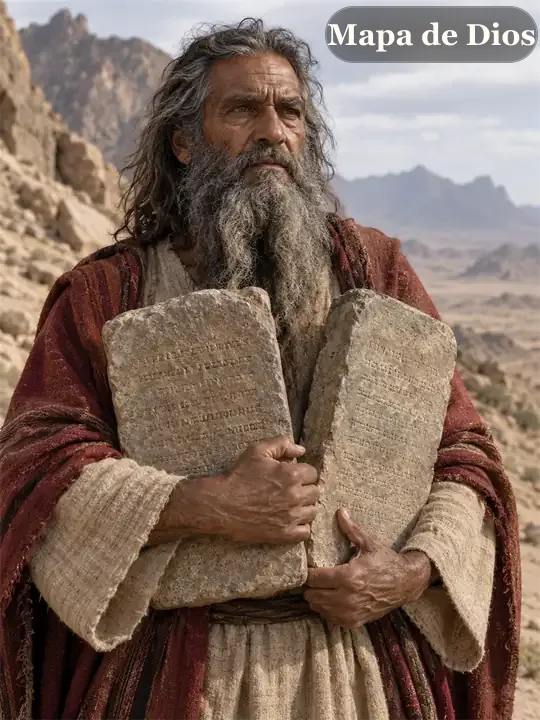
- On Mount Sinai he received from God the tablets of the Law, with the Ten Commandments. Exodus 31:18; Exodus 34:28
- The name
- Pharaoh’s daughter named him Moses because she drew him out of the water: in Hebrew, the name sounds like “to draw out.” Its origin is probably Egyptian. Exodus 2:10; NAB note on Ex 2, 10
- Also called
- The servant of the Lord Deuteronomy 34:5 · The man of God Deuteronomy 33:1
- From
- Egypt. He was from the tribe of Levi Exodus 2:1-2; Exodus 6:16-20
- Occupation
- Shepherd of the flock of his father-in-law Jethro, in Midian Exodus 3:1
- Feast day
- September 4: Saint Moses, prophet
What the Bible says
Exodus 2:3-10
3And when she could hide him no longer, she took a basket made of bulrushes, and daubed it with slime and pitch: and put the little babe therein, and laid him in the sedges by the river’s brink, 4His sister standing afar off, and taking notice what would be done. 5And behold the daughter of Pharao came down to wash herself in the river: and her maids walked by the river’s brink. And when she saw the basket in the sedges, she sent one of her maids for it: and when it was brought, 6She opened it and seeing within it an infant crying, having compassion on it she said: This is one of the babes of the Hebrews. 7And the child’s sister said to her Shall I go and call to thee a Hebrew woman, to nurse the babe? 8She answered: Go. The maid went and called her mother. 9And Pharao’s daughter said to her. Take this child and nurse him for me: I will give thee thy wages. The woman took, and nursed the child: and when he was grown up, she delivered him to Pharao’s daughter. 10And she adopted him for a son, and called him Moses, saying: Because I took him out of the water.
Exodus 3:2, 10
2And the Lord appeared to him in a flame of fire out of the midst of a bush: and he saw that the bush was on fire and was not burnt. 10But come, and I will send thee to Pharao, that thou mayst bring forth my people, the children of Israel out of Egypt.
Exodus 31:18; Exodus 34:28
And the Lord, when he had ended these words in mount Sinai, gave to Moses two stone tables of testimony, written with the finger of God.
Douay-Rheims Bible (Challoner revision), public domain.
The path of Moses
- Before Jesus. He was born when Pharaoh had ordered that the baby boys of the Hebrews be thrown into the river. Exodus 1:22; Exodus 2:1-2
- Before Jesus. His mother hid him for three months and put him in a basket by the river. Pharaoh’s daughter adopted him. Exodus 2:2-10
- Before Jesus. As a grown man, he killed an Egyptian who was beating a Hebrew, and he fled to Midian. Exodus 2:11-15
- With Jesus. On Mount Horeb, God called him from a bush that was burning but not burned up, and sent him to Pharaoh. Exodus 3:1-10
- With Jesus. With his brother Aaron, he asked Pharaoh to let the people go. After the plagues and the Passover, Pharaoh let them leave. Exodus 5:1; Exodus 12:29-31
- With Jesus. He stretched out his hand over the sea, and the Israelites crossed it on dry land. Exodus 14:21-22
- With Jesus. On Mount Sinai he received the Law from God, with the Ten Commandments. Exodus 20:1-17; Exodus 34:28
- Afterward. He led the people through the desert for forty years. He died on Mount Nebo, after seeing the promised land from far away. Acts 7:36; Deuteronomy 34:1-5
Words of Moses
“Who am I that I should go to Pharao, and should bring forth the children of Israel out of Egypt?” Exodus 3:11
When God spoke to him from the bush and sent him to Pharaoh.
“I beseech thee, Lord. I am not eloquent from yesterday and the day before: and since thou hast spoken to thy servant, I have more impediment and slowness of tongue.” Exodus 4:10
When God was sending him, and he did not feel able to speak.
“Fear not: stand and see the great wonders of the Lord, which he will do this day: for the Egyptians, whom you see now, you shall see no more for ever.” Exodus 14:13
Facing the sea, with Pharaoh’s army behind them.
“I beseech thee: this people hath sinned a heinous sin, and they have made to themselves gods of gold: either forgive them this trespass, or if thou do not, strike me out of the book that thou hast written.” Exodus 32:31-32
When he asked God to forgive the people, after the golden calf.
“Hear, O Israel, the Lord our God is one Lord. Thou shalt love the Lord thy God with thy whole heart, and with thy whole soul, and with thy whole strength.” Deuteronomy 6:4-5
When he was teaching the people the Law of God, before they entered the promised land.
What they were like
- He defended Jethro’s daughters from some shepherds, and he watered their flock. Exodus 2:16-17
- He did not feel able: he told God that he did not speak well and asked him to send someone else. Exodus 4:10, 13
- The Bible says he was the meekest man on earth. Numbers 12:3
- He got angry: when he saw the golden calf, he threw down the tablets and broke them to pieces. Exodus 32:19
The greatest thing they did
- He led the people of Israel out of Egypt. Exodus 3:10; Acts 7:36
- He received from God the Ten Commandments and the covenant of Sinai. Exodus 24:7-8; Exodus 34:28
- He prayed for the people after the golden calf, and God did not destroy them. Exodus 32:11-14
Not to be confused with
- Aaron: Aaron was his older brother and spoke for him. It was Aaron, not Moses, who made the golden calf. Exodus 4:14-16; Exodus 7:7; Exodus 32:4
- His sister is named Miriam. The Spanish Bible of 1836 calls her “Mary the prophetess,” but she is not the mother of Jesus. Exodus 15:20; Numbers 26:59
In the Church today
Feast day: September 4, Saint Moses, prophet (commemoration (not on the General Roman Calendar or the U.S. calendar)). Roman Martyrology (2004)
In art, recognized by: The two stone tablets of the Law From Ex 34, 29; this is how Christian art shows him; Two rays of light on his forehead; sometimes, two horns From Ex 34, 29: the Vulgate says “cornuta,” horned; the Spanish Bible of 1836 translates “rays of light”
What people ask
Why did Moses not enter the promised land?
At Meribah, God told Moses and Aaron that they had not believed him. So they would not lead the people into that land; Moses saw it from Mount Nebo. Numbers 20:12; Deuteronomy 34:1-4
How many years did he live?
One hundred and twenty. When he died, his eyes were still good and he was still strong. Deuteronomy 34:7
Where is he buried?
In a valley in Moab, but the Bible says that no one knows where his grave is. Deuteronomy 34:6
What does “I am who am” mean?
It is the name God revealed to Moses at the bush. The Catechism explains that only God IS, without beginning and without end. Exodus 3:14; Catechism 213
What does Moses have to do with Jesus?
Moses appeared talking with Jesus at the Transfiguration. And Jesus said that Moses had written about him. Matthew 17:3; John 5:46
Daily life He alone judged the people’s disputes, from morning to evening. His father-in-law, Jethro, advised him to share the work. Exodus 18:13-24 He went up to speak with God,…
The rest of this page (daily life, failings, little-known facts, for you…) is part of the subscription.
See the mapWho Moses is connected to
- Joseph, son of Jacob · carried his bones
- Aaron · brothers
- Jesus · wrote about him · the Law and grace · the bronze serpent · the bread from heaven · a prophet like him · servant and Son · the paschal lamb · the Last Supper
- Elijah · together with Jesus
- Miriam · brother and sister
- Jethro · father-in-law and son-in-law
- Zipporah · husband and wife
- The Pharaoh of the Exodus · face to face
- Joshua · aide and successor
- Stephen · recalled him before the council
More people
All the people of the Bible · The Twelve Apostles · Women of the Bible